
Peptides
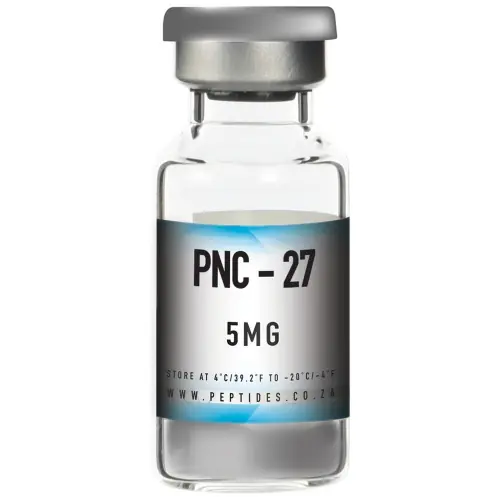
PNC-27
5MG per vial
- Purity
- 97%+
- Size
- 1 vial
- Form
- Powder
R550Excl. VAT
Or 4 interest-free payments with
Induces Tumor Cell Necrosis
1
- Injectable peptides come with all the water you need and 10 free syringes
- Door-to-door courier or Postnet to Postnet, anywhere in South Africa
- Individually labelled and packed in heat-resistant material
- Pay with Payflex or EFT
Introduction
PNC-27 is the anti-cancer peptide, which is a membrane-active peptide that binds to the HDM-2 protein expressed in the cancer cell membranes of solid tissue tumor cells and induces transmembrane pore formation in cancer, but not in normal cells, resulting in tumor cell necrosis that is independent of p53 activity in these cells. We now extend our study to non-solid tissue tumor cells, in this case, a primitive, possible stem cell human leukemia cell line (K562) that is also p53-homozygously deleted. Our purpose was twofold: to investigate if these cells likewise express HDM-2 in their plasma membranes and to determine if our anti-cancer peptide induces tumor cell necrosis in these non-solid tissue tumor cells in a manner that depends on the interaction between the peptide and membrane-bound HDM-2.
The anti-cancer activity and mechanism of PNC-27, which carries a p53 aa12-26-leader sequence connected on its carboxyl terminal end to a trans-membrane-penetrating sequence or membrane residency peptide (MRP), was studied against p53-null K562 leukemia cells. Murine leukocytes were used as a non-cancer cell control. Necrosis was determined by measuring the lactate dehydrogenase (LDH) release and apoptosis was determined by the detection of Caspases 3 and 7. Membrane colocalization of PNC-27 with HDM-2 was analyzed microscopically using fluorescently labeled antibodies against HDM-2 and PNC-27 peptides.
Dosing Details
You inject 2ml water into the vial of PNC-27 from the water vial. 1 full syringe is 1ml. you then wait for the vial powder content to dissolve and once dissolved and clear you draw out 10 - 20 (1 - 2 units / 100 to 200 mcg) on the syringe and inject it around the site of cancer tumor/site or as close as possible to this area, into the skin under the skin into the fatty skin layer.
How long will a vial last ?
A vial should last 10-20 days
More from this category
All Peptides
For research use only. Not for human or animal consumption.